 Townrow, Jocelyn Elizabeth Suzanne (née Davies) (1932 - 2006)
Born in 1932 in in New Zealand; died on 14 April 2006 in Hobart, Tasmania.
Although born in New Zealand, Jocelyn
grew up on the Isle of Wight, UK.
After finishing her
schooling, she gained a degree in agricultural botany
at the University of Reading, UK.
At Reading she met her
husband, John A. Townrow (1927-2018), who she married in 1955 and went on to have three
children.
[After a divorce John married again and established another family in the USA.]
In 1960, having lived for a time in Nigeria,
she moved with her family to Hobart, where, at the
University of Tasmania, she completed her doctorate
and worked as a lecturer and researcher until her
retirement in 1983.
Her PhD, awarded in 1976 was for her thesis:
'Studies in the genus Stipa L. (Graminaceae) in Tasmania : taxonomy and distribution of the species'
(Stipa, in her sense, is now called Austrostipa)
The extent of her work as a
researcher is evident in her papers, held by the
Tasmanian Herbarium.
This collection
contains material Townrow gathered and prepared
while studying the genus of grasses then known as
Stipa.
At its heart are three hundred pages of detailed
notes that record her observations of Stipa, along
with numerous sketches, photographs and letters.
These are accompanied by five hundred pen-and-ink
drawings, as well as hundreds of the
drawings laid-out 'for publishing', and almost as many
black-and-white photographs.
After her retirement, Townrow developed an interest
in alternative health therapies and served as State
President of the National Association of Sustainable
Agriculture, and as a Trustee of the Royal Tasmanian
Botanical Gardens.
Source: Extracted from:
The web Ryerson Index for Townrow, Jocelyn Elizabeth Suzanne.
'Under the Microscope at the Herbarium' Tas. Herb. online newsletter:
Advancing Science - The Labours of Jocelyn Townrow.
Pers.Comm B.Robinson-M.Fagg March 2026.
Portrait Photo: c 1951, supplied by Barrie Robinson.
.
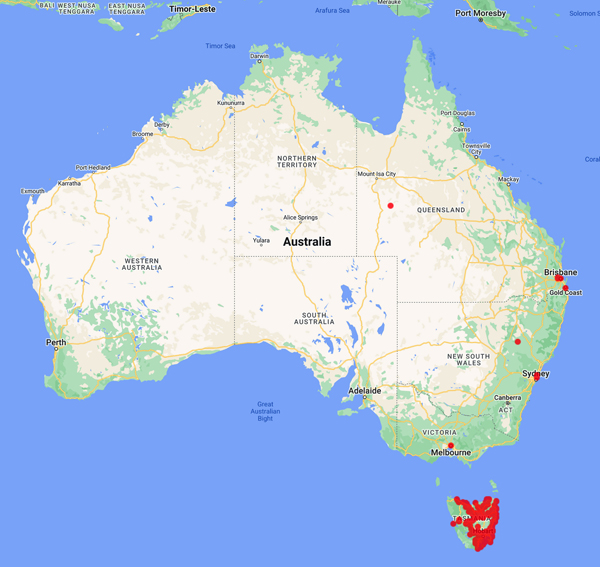
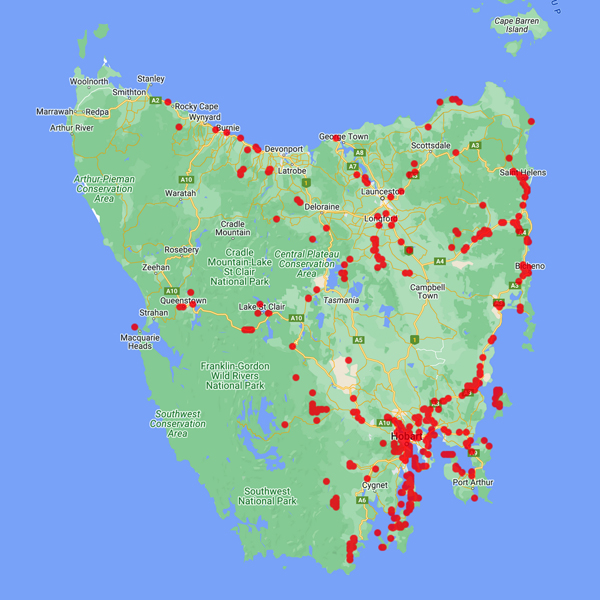
Collecting localities for 'Townrow, J.E.S.' from AVH (2024)
Data from 1,064 specimens